
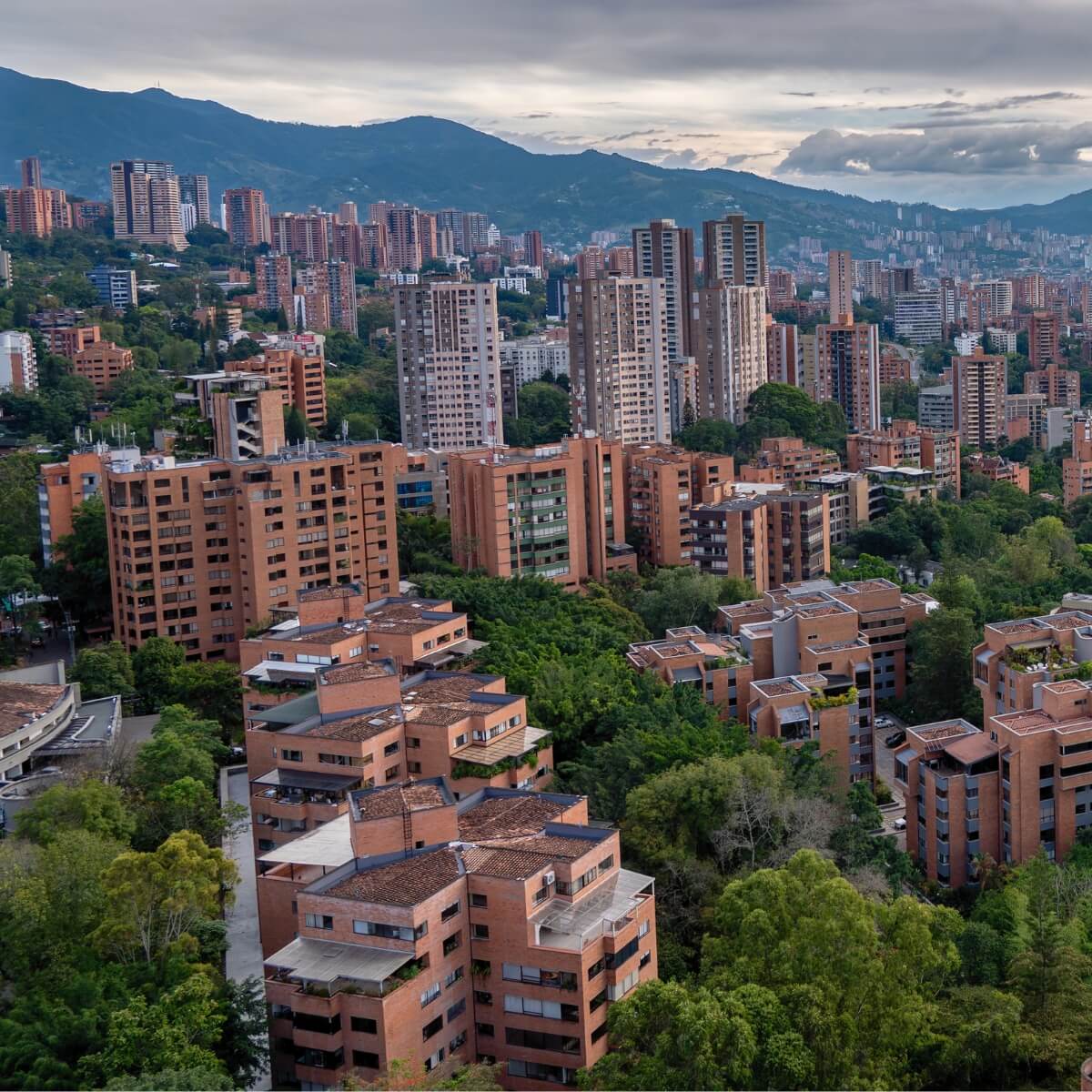
Ask almost any foreigner why they ended up in Medellín, and somewhere in the answer you’ll hear a version of the same thing: the money goes further here. It’s not a myth. If you earn in dollars, euros, or another strong currency and spend in Colombian pesos, the exchange rate alone does a meaningful part of the work — turning a comfortable income back home into a genuinely upgraded lifestyle here.
But “Medellín is cheaper” is where most articles stop, and it’s an incomplete answer. The real question isn’t whether Medellín is affordable — it’s affordable compared to what. The cost of living here isn’t one number. It changes significantly depending on where in the city you live, and that difference comes down to a Colombian system most newcomers have never heard of: estratos.
What Estratos Actually Are
Colombia classifies residential sectors on a scale from 1 to 6, according to the socioeconomic profile of the zone — estrato 1 being the most modest, estrato 6 the most exclusive. It’s a classification of the sector you live in, not a label on you personally, and its original purpose was practical: it allows utility costs to be distributed fairly across the city, with higher estratos paying more for electricity, water, and gas so that lower estratos can pay less.
The practical effect for you as a buyer or renter: your estrato doesn’t just describe your neighborhood’s reputation, it directly shapes your monthly budget — housing, utilities, and even everyday spending tend to move together as you go up or down the scale.
Estrato 5–6: El Poblado and Laureles
This is where most foreign buyers end up, and it’s easy to see why — the strongest social scene, the highest concentration of restaurants, and the best access to commercial and financial services in the city. It’s also the most expensive tier by a meaningful margin.
A comfortable monthly lifestyle here — for a single person living well, not extravagantly — typically lands between COP 8,000,000 and COP 12,000,000. Roughly how that breaks down:
- Housing: Renting a one- to two-bedroom unfurnished apartment in El Poblado typically runs COP 3.5M–6.5M/month. In Laureles, straight estrato 5, expect a similar range, sometimes slightly lower depending on the building. For owners, budget administración (the monthly building fee, commonly COP 400,000–1M+ depending on amenities) plus predial (annual property tax, often COP 3M–6M/year for a well-located apartment in this tier).
- Utilities: Electricity, water, and gas combined typically run COP 500,000–600,000/month.
- Food & lifestyle: Groceries, dining out, and everyday spending in this tier reflect the neighborhood’s restaurant-heavy, international character — typically COP 2M–3.5M/month for someone eating out regularly and shopping at both local and imported-goods markets.
Estrato 3–4: Sabaneta and Parts of Envigado
This tier has quietly become one of the smartest plays in the city — strong quality of life, noticeably lower cost, and Metro access in both municipalities.
A comfortable monthly lifestyle here typically lands between COP 5,000,000 and COP 8,000,000:
- Housing: Rents typically run COP 2.5M–3.5M/month for a comparable unit. Administración and predial follow the same downward pattern — meaningfully less than an equivalent estrato 6 property.
- Utilities: Combined electricity, water, and gas typically run COP 250,000–450,000/month.
- Food & lifestyle: Groceries and dining out cost less here than in El Poblado for comparable quality, typically COP 1.2M–2M/month.
Estrato 1–2: The Barrios Populares
These are Medellín’s working-class sectors — not where foreign buyers or long-term expats typically settle, but worth understanding, since they anchor the low end of the city’s cost spectrum and make up a large share of its housing.
A monthly cost of living here typically falls between COP 2,000,000 and COP 4,000,000:
- Housing: Often COP 800,000–1.5M for rent, though quality, security, and access to services vary significantly by specific barrio.
- Utilities: The lowest rates in the city.
- Food & lifestyle: Considerably lower than higher estratos, though also with less access to the restaurants and imported goods common in El Poblado or Laureles.
The Real Takeaway
None of this means one tier is “right” and another is “wrong” — it means the honest answer to “what does it cost to live in Medellín” depends entirely on which version of the city you’re picturing. Knowing the full range, and understanding what estrato is quietly doing to your monthly budget, is what lets you plan accurately instead of guessing.
The Medellín Buyer Guide walks through cost of living, neighborhoods, and the full buying process in one place — download it to see the complete picture. → Download the Buyer Guide
Note: All figures in this article are approximations based on current market conditions and are intended as a general reference. Actual costs can vary significantly depending on property type, building, and individual lifestyle.